Read the wage correctly. Welders, cutters, solderers, and brazers, combined national occupational group A national median is not an entry-level wage, a local quote or a guarantee of earnings.
The most useful starting question is not “How quickly can I become a welder?” It is “Which welding job am I trying to qualify for?” A course can be well taught and still be poorly matched to the employers you can reach. Build your plan around local work requirements, the processes taught, and the evidence you will have of your skills when you apply.
A dated national benchmark, not a specialty-pay promise
BLS reports $53,750 median annual pay in May 2025 for the combined group of welders, cutters, solderers, and brazers. It projects 2% employment growth from 2025 to 2035. Typical preparation includes high school or equivalent, technical instruction, and workplace training. The combined median does not describe every welding specialty or guarantee a beginner's income. Read the BLS welding profile.
Turn job advertisements into a training brief
Collect advertisements for roles that fit your travel radius and intended schedule. Put the repeated requirements into a simple table: welding process, material, position, drawing-reading expectations, testing, previous experience, and shift. Leave a field blank when an advertisement does not specify it. Then ask the employer what an entry applicant must demonstrate.
Take that table to a training provider. Instead of asking whether the course is “industry recognized,” ask how its teaching and assessment correspond to each requirement. A useful answer should identify what you will practice, how progress is checked, and what remains outside the course. Keep the response so you can compare the same points with another provider.
Separate course completion from a particular qualification
Ask the school to name every document you will receive. Does it confirm attendance, completion of a program, or a specific tested performance? Request the scope and conditions in plain language. If the document includes a process, material, position, or other limitation, ask what that limitation means for the roles you want.
Do not treat one credential as proof that you can perform every kind of welding work. Ask prospective employers which tests they require and whether they conduct their own assessment. If an employer requests a qualification you have not investigated, follow up with the organization responsible for it before purchasing extra training.
Investigate practice access before comparing tuition
Ask how much supervised practice is scheduled and how many learners share a station. Request a description of instructor feedback and the way a student earns another attempt after an unsuccessful assessment. Also ask how consumables, equipment access, and missed sessions are handled. These questions test what your tuition buys without assuming that a longer or more expensive course is automatically better.
Arrange a visit if possible and compare what you see with the timetable you were given. Ask which course activities are prerequisites for later sessions, so you understand the effect of an absence. Write down your own observations and avoid treating a sales tour as a substitute for the written program details.
Budget for the route to your first application
Request an itemized quote for tuition, materials, protective equipment, tools, assessments, retesting, and other required charges. Add travel and any work hours you would give up to attend. Use the actual payment schedule to test affordability rather than dividing the price into a convenient monthly figure yourself.
Compare employer training and apprenticeships where available. The federal Apprenticeship.gov career-seeker tools are a starting point for finding paid opportunities, not a guarantee that a particular local vacancy exists. Keep school applications and job applications on the same calendar so that one deadline does not unintentionally remove an alternative.
Plan the conversation with your first employer
Prepare a concise description of your training: what you practiced, what you were assessed on, and what you are still learning. Ask how the employer evaluates a new applicant and what documents to bring. Be specific and honest; a precise statement of your current skills is more useful than calling yourself qualified for an undefined range of work.
Before signing an enrollment contract, use the FTC's vocational-school guide as an additional checkpoint. Keep unresolved questions visible in your comparison sheet. An unanswered question is a reason to obtain information, not a reason to fill the gap with an optimistic assumption.
Welding, cutting, soldering and brazing
BLS covers four related jobs. Welders join metal parts, most commonly with arc processes that use electric current to create heat. Cutters use an electric arc, plasma or burning gases to trim metal or dismantle large structures such as ships and railcars. Solderers join small, precisely positioned parts with a lower-temperature filler, as in electronics. Brazers join dissimilar metals with a filler and may apply protective coatings. Typical duties include reading blueprints and specifications, measuring and inspecting parts, welding to specification, adjusting heat and maintaining equipment.
Where welders work
| Employer type | Share of jobs | Median annual wage |
|---|---|---|
| Manufacturing | 63% | $51,210 |
| Specialty trade contractors | 8% | $59,440 |
| Self-employed workers | 4% | Not covered by BLS wage data |
| Repair and maintenance | 4% | $56,080 |
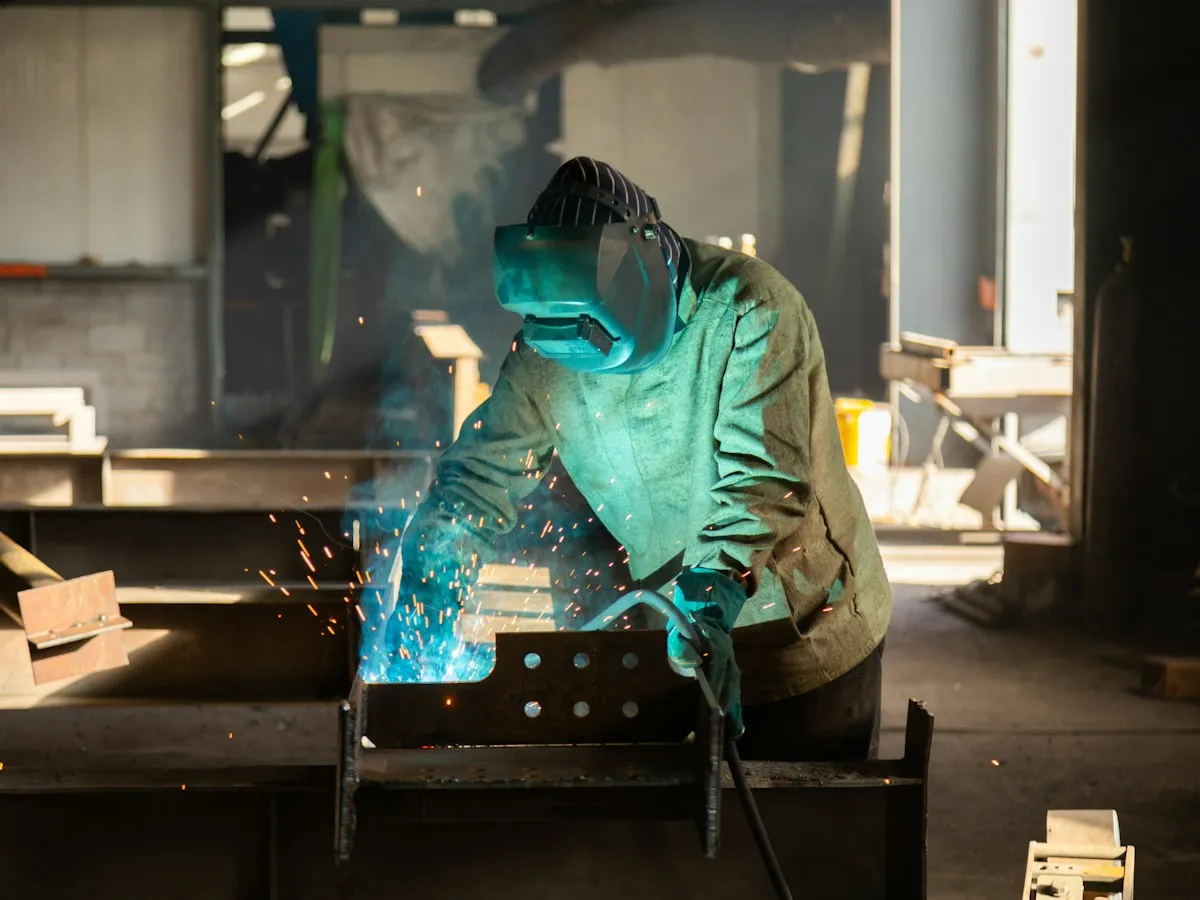
BLS counted about 437,700 jobs in 2025, most of them in factories. Work can be outdoors in any weather or indoors in booths built to contain sparks and glare, sometimes on scaffolds high above the ground, often in awkward positions. Many manufacturers run two or three shifts of 8 to 12 hours, so evening and weekend work is common, and some welders work more than 40 hours a week.
Hazards to plan for. BLS names fumes, very hot materials and intense arc light. Welders use helmets, hearing protection and heat-resistant gloves and must complete OSHA-required electrical safety training. Ask how a school or employer handles ventilation and protective equipment.
Read the pay range, not only the median
| Measure | Annual wage |
|---|---|
| Lowest 10% earned less than | $39,240 |
| Median | $53,750 ($25.84 per hour) |
| Highest 10% earned more than | $77,530 |
BLS says pay varies with experience, skill level, industry and company size. The all-occupation median was $50,980. Specialized work you may read about online, such as pipeline or underwater welding, is not separated in these figures, so treat claims about very high pay as something to verify with a real employer.
Training and certification
- Entry: a high school diploma or equivalent is typical, but employers often prefer or require technical training from high school programs, vocational institutes, community colleges, private welding schools or the Armed Forces.
- Useful coursework: blueprint reading, shop mathematics, mechanical drawing and basic electricity.
- On the job: even trained welders typically receive several months of on-the-job training. Some employers run apprenticeships, including some open to workers with no experience.
- Licensing: some states and localities require welders to be licensed; check the agency where you will work.
- Certification: some employers require general or job-specific certification and may pay for training and testing.
One widely used option is the American Welding Society Certified Welder program. According to AWS, it is performance-based with no written exam and no education or experience prerequisites, tests are taken at AWS Accredited Test Facilities, testing fees are set by each facility, and the certification is portable between employers but must be kept active with periodic maintenance documentation. Confirm which test (process, position and material) your target employer actually asks for before booking one.
What the job outlook is based on
BLS projects 2% growth from 2025 to 2035, slower than the 3% average, but still about 40,300 openings a year, mostly to replace workers who retire or change occupations. Demand comes from rebuilding aging infrastructure and from manufacturing, while automation may limit growth. Slow growth with steady replacement openings means local employer demand matters more than the national headline. Compare this route with plumbing and pipefitting in welding vs. plumbing.
Common questions
How long does welding school take? Compare the actual course schedule and objective. There is no single course length that establishes readiness for every job.
Will a certificate guarantee employment? No. Ask what it documents and compare that with an employer's entry criteria and assessment.
What should I do this week? Collect five relevant job advertisements, identify their repeated requirements, and ask two training providers to respond to the same list.
Do I need certification before my first job? Not always. Some employers hire trainees and pay for testing; others ask for a specific certification. Check real job postings near you.
Sources & verification
Sources checked October 20, 2026. Statistical reference dates are stated separately. Official application rules may change.