Read the wage correctly. Electricians, national occupation A national median is not an entry-level wage, a local quote or a guarantee of earnings.
An electrician career is easier to evaluate when you separate three decisions: the work you want, the training you can enter, and the authorization required where you will work. Start with those decisions before comparing school advertisements. A useful plan should name a local entry route and explain what your first year would actually look like.
National facts, with the dates attached
The U.S. Bureau of Labor Statistics reports a $63,190 national median annual wage in May 2025 for electricians and projects 9% employment growth from 2025 to 2035. Most electricians train through an apprenticeship, commonly lasting four or five years. Most states require a license. These are national descriptions, not a promise about your starting pay or your state's rules. Read the BLS electrician profile.
Choose the kind of electrical work you want to explore
Write down two or three settings that interest you: residential installation, commercial construction, industrial maintenance, or another clearly described specialty. Then collect local job advertisements for each. Use the advertisements as interview prompts rather than assuming that every requirement applies to a beginner. Highlight references to travel, shifts, driving, tools, customer contact, and previous experience.
Contact a prospective sponsor or employer with a precise question: “I am applying for my first electrical role. Which of these requirements must I already meet, and which do you train?” Keep the answer alongside the advertisement. This small step gives you something concrete to compare when two programs use similar sales language.
Compare an apprenticeship with school before paying a deposit
A Registered Apprenticeship combines paid work, instruction, mentoring, and a recognized completion credential. Search the federal Apprenticeship.gov career-seeker tools, then apply directly to the employer or sponsor. An opening on a search site is a lead to investigate; it is not an admission offer.
For each route, create a one-page record with the application deadline, required documents, selection process, classroom schedule, work location, first-year wage, and person who confirmed the details. If you are considering school first, ask the apprenticeship sponsor whether that particular course will receive credit. Request the answer in writing before including a shortened training period in your plan.
Treat license eligibility as a separate checkpoint
Find the electrical licensing authority for the state or locality where you intend to work. Ask which credential applies to your proposed role, how supervised experience is documented, and whether school hours count. Also ask who can verify your experience if an employer closes or you change jobs. Save the official page and its date rather than relying on a recruiter saying that a course is “license ready.”
Do not assume that permission to work as an employee also permits you to advertise or contract independently. If self-employment is a future goal, put that in a separate research column. A licensing board's answer is more useful than a generic national checklist for this decision.
Build a first-year budget that can survive a delay
Use confirmed local figures for tuition, books, tools, protective equipment, examinations, transportation, and parking. Put uncertain amounts in a separate column instead of replacing them with a national average. Include the time between application and the first paid workday, along with any daytime classes that would conflict with your existing job.
Make two versions: one based on the schedule you have been offered and one with a delayed start. Keep overtime out of the basic household budget until you have a reason to expect it. The purpose is to test whether the route remains workable, not to predict your future earnings.
Your practical next steps
During your first week, shortlist three local entry routes and identify the relevant licensing authority. Next, gather the application requirements and ask one question that is missing from each program's public information. Finally, compare the responses using the same headings, and choose where to apply before deciding what to buy.
If a provider cannot explain the credential, the total charges, or the route from completion to employment, pause that option while you investigate alternatives. For a broader enrollment checklist, use the FTC guide to vocational schools.
What electricians actually do
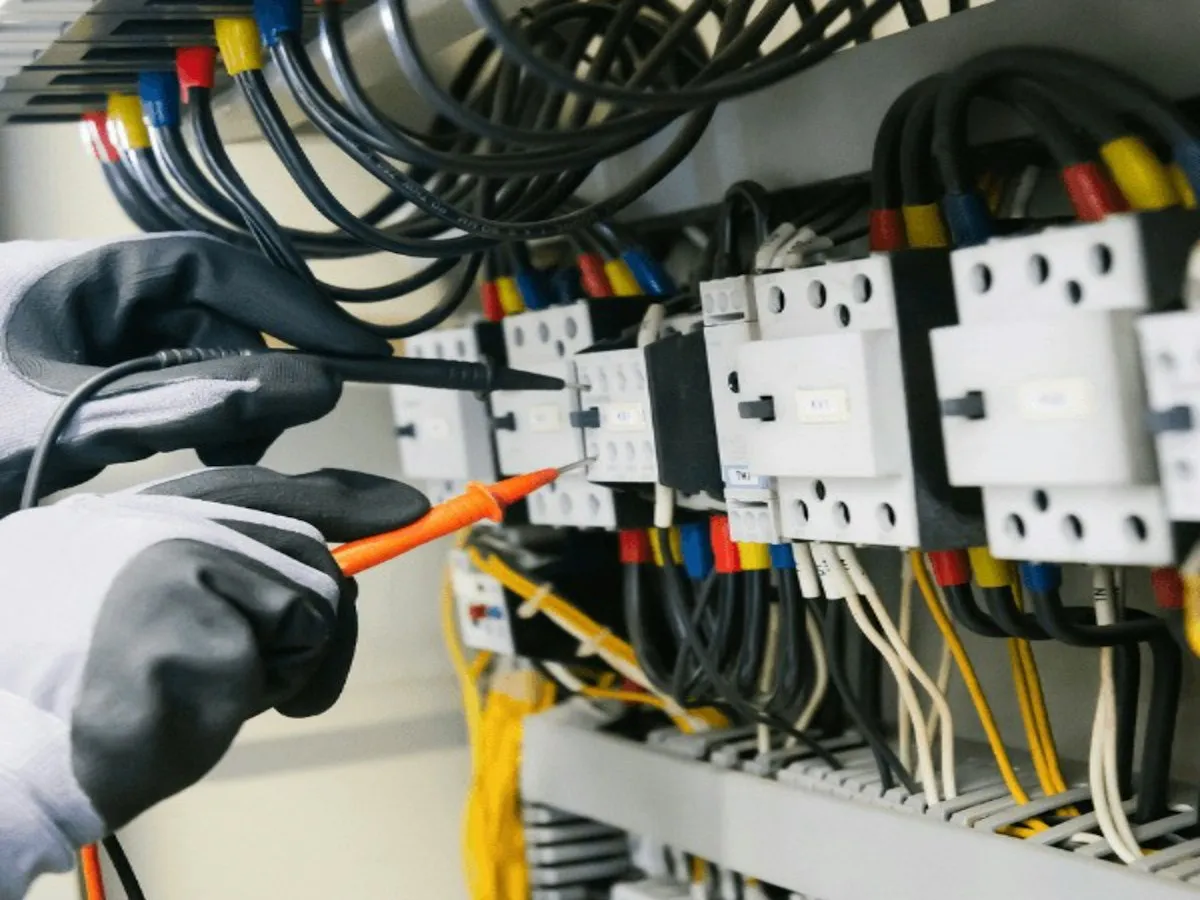
BLS describes the core work as installing, maintaining and repairing electrical power, communications, lighting and control systems in homes, businesses and factories. In practice, that means reading blueprints and circuit diagrams, running and connecting wiring, inspecting components such as transformers and circuit breakers, diagnosing faults with test instruments, and replacing failed wiring, equipment or fixtures. Electricians follow state and local building rules based on the National Electrical Code, and experienced workers direct and train helpers and apprentices.
New-construction wiring and maintenance work feel different day to day. Wiring a building while walls are open is usually more straightforward; maintenance can mean tracing a fault through equipment that is hard to reach. Linework on distribution and transmission lines is a separate occupation in the BLS handbook, so do not assume that an inside-wiring apprenticeship prepares you for utility line work.
Where electricians work
| Employer type | Share of electrician jobs | Median annual wage |
|---|---|---|
| Electrical contractors and other wiring installation contractors | 66% | $61,570 |
| Self-employed workers | 7% | Not covered by BLS wage data |
| Manufacturing | 6% | $74,550 |
| Government (excluding state and local education and hospitals) | 3% | $79,820 |
| Employment services | 2% | $57,760 |
BLS counted about 821,000 electrician jobs in 2025. Most are with contractors, which is why commuting between jobsites, and sometimes long-distance travel, is part of the job. Expect cramped spaces, long periods of standing and kneeling, dust or fumes and work at heights; outdoor work adds heat, cold and weather. Almost all electricians work full time. Evening and weekend hours are possible, and overtime is common during scheduled maintenance and on construction sites.
Safety is part of the career decision. BLS lists electrical shock, falls and burns among common injuries and notes that accidents can be fatal. Ask any sponsor or employer how safety training, supervision and protective equipment work for new apprentices.
Read the pay range, not only the median
| Measure | Annual wage |
|---|---|
| Lowest 10% earned less than | $42,640 |
| Median (half earned more, half less) | $63,190 ($30.38 per hour) |
| Highest 10% earned more than | $108,510 |
The spread between the lowest and highest tenth is large because it mixes beginners and experienced workers, different industries and different regions. For comparison, BLS reports a $58,150 median for all construction trades workers and $50,980 for all occupations. Use these figures as context; your planning number should be the written starting wage and progression schedule from a real apprenticeship or employer offer.
How an electrical apprenticeship is structured
- Length: most electricians train through an apprenticeship of four or five years.
- Paid work: each year typically includes about 2,000 hours of paid on-the-job training.
- Technical instruction: electrical theory, blueprint reading, mathematics, electrical code requirements, safety and first aid. Some programs add soldering, communications, fire alarm systems or elevators.
- Sponsors: unions and contractor associations sponsor many programs; requirements vary by state and locality.
- Shortened routes: military or construction experience may qualify some applicants for a shorter apprenticeship after assessment. Graduates of a technical school usually receive some credit, but ask the sponsor to confirm credit for your specific course in writing.
- Not every training plan is an apprenticeship: BLS notes that some contractors run in-house training that is not a recognized apprenticeship. Ask whether a program is registered before treating its hours as apprenticeship hours.
Our step-by-step guide to applying for an electrical apprenticeship covers union JATC and open-shop routes, the aptitude test and the waiting list.
Credentials across a career
Completing an apprenticeship makes you a journey-level worker. Most states then require a licensing examination, which typically covers the National Electrical Code and state and local codes, and continuing education is often needed to keep a license. With further experience, journey workers can become master electricians, supervisors or project managers. Optional certifications exist for areas such as solar photovoltaic, electrical generating and lighting systems.
Rules are set by each state and sometimes by a city or county. As a worked example, our Texas electrician license guide shows how one regulator separates apprentice registration, exam eligibility and the experience required for a journeyman license.
Is the work a good fit? A quick self-check
- Color vision: wires are identified by color. If you have a color-vision difference, ask an employer how they handle it before you invest in training.
- Troubleshooting: do you enjoy finding the cause of a problem from test results?
- Physical demands: BLS mentions long days running wire and moving components weighing up to about 50 pounds.
- Customer contact: residential and service work involves explaining problems and options to clients.
What the job outlook is based on
BLS projects employment to grow 9% from 2025 to 2035, adding about 75,900 jobs, with roughly 72,700 openings a year. Most openings replace workers who retire or move to other occupations. BLS links demand to power systems in new and existing buildings, connecting solar and wind generation, rising electricity demand from data centers and artificial intelligence, and grid upgrades. A national projection is not a forecast for your area; local job postings and sponsor intake numbers are better evidence for your next step.
Not sure between two trades? Compare HVAC and electrical work on the same data.
Common questions
Is electrical school the same as an apprenticeship? No. Ask who employs you, who provides instruction, and what completion document you receive. Compare the actual offer, not the course title.
Is the national median a beginner's salary? No. Use it as a dated national benchmark. Ask local sponsors for the actual starting wage and progression schedule.
What should I do first? Identify a local entry route and the licensing authority before committing to tuition or a large tool purchase.
Can I start without experience? Yes for many sponsors, but most require a high school diploma or equivalent and some ask for a year of algebra and an aptitude test. Read our application guide.
A documented sponsor example in Texas
Austin Electrical Training Alliance illustrates why an application fee, tuition, workplace hours and a license must be kept separate. Our comparison identifies the published figures and the questions that remain open.
Sources & verification
Sources checked October 20, 2026. Statistical reference dates are stated separately. Official application rules may change.